
Custom GPT
Lead Magnet
Fit-check Tool
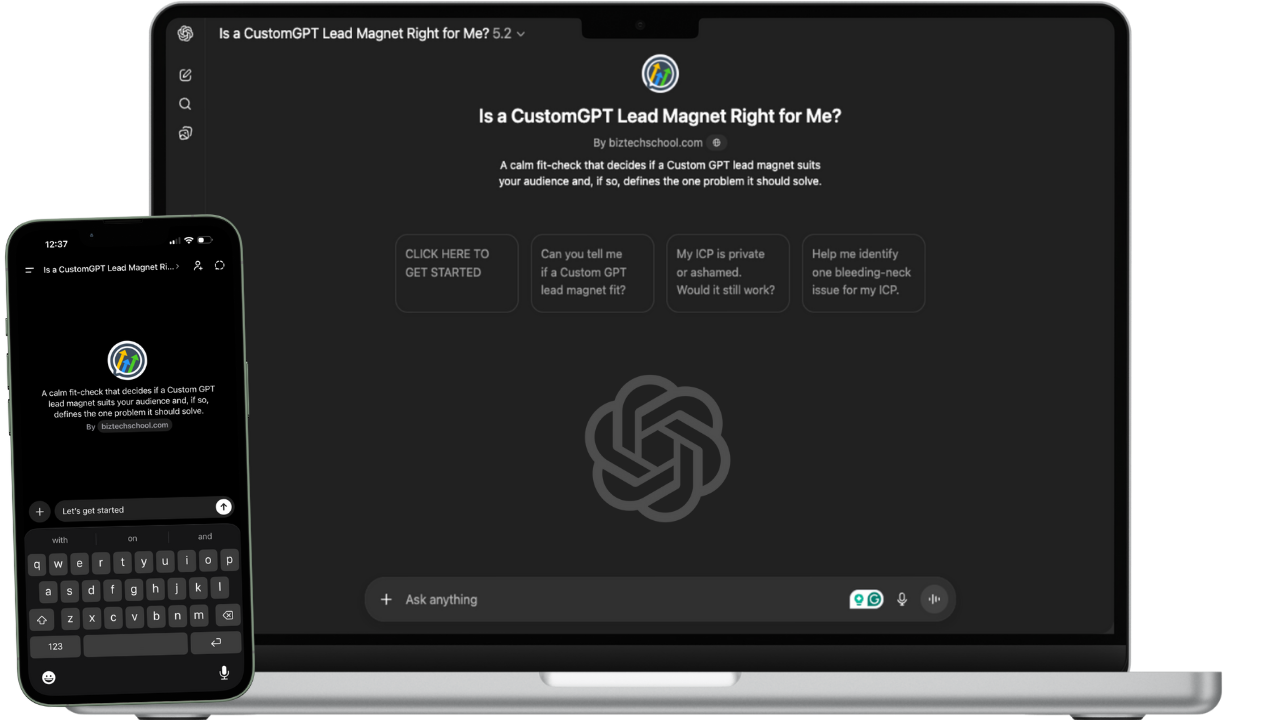
Check if a Custom GPT lead magnet makes sense for your audience.
It looks at your ideal client to identify challenges well-suited to a GPT lead magnet.
A Smarter Way to Generate Leads in 2026
A better first step than PDFs, quizzes, and free courses — not a replacement for real conversations
A Custom GPT Lead Magnet is a focused, interactive assistant designed to help a specific audience with one defined problem using the coach or consultant’s way of thinking.
It is not general ChatGPT.
It is intentionally:
Narrow in scope
Trained with specific instructions
Designed to deliver clarity, not comprehensive solutions
Its job is to provide a useful first step — not a full transformation.
What a Custom GPT Lead Magnet IS
✔️ A guided thinking space
✔️ A private, low-pressure entry point
✔️ A way to deliver value before a sales conversation
✔️ A trust-building tool
✔️ A qualifier for readiness, not a persuader
It helps someone:
✔️ Understand what’s really going on
✔️ Label the problem more clearly
✔️ Feel seen and understood
✔️ Decide whether they want further support
What a Custom GPT Lead Magnet IS NOT
❌ A replacement for the coach or consultant
❌ A clone of the coach’s entire brain (“KarlBot”)
❌ A therapy session, diagnosis tool, or advice engine
❌ A general AI chat trained on the internet
❌ A promise of outcomes
If built correctly, it should increase desire for human support, not reduce it.
Key Distinction
The GPT handles orientation and clarity.
The human handles nuance, accountability, and change.
EXAMPLE
Transformation / Habit Coach
Audience:
Senior professionals under chronic stress
Problem:
Using alcohol to switch off in the evenings
GPT Role:
Helps the user understand the stress → relief loop, name triggers, and explore low-friction alternatives — without judgement or pressure to quit.
Why it works:
Private, anonymous, reflective — ideal for shame-sensitive topics.
EXAMPLE
Business Coach
Audience:
Coaches getting leads but not converting
Problem:
“I don’t know why calls aren’t turning into clients”
GPT Role:
Walks the user through recent calls, helps spot patterns, and identifies one improvement area.
Why it works:
Personalised analysis beats generic sales PDFs.
EXAMPLE
Leadership Coach
Audience:
New managers
Problem:
Avoiding difficult conversations with team members
GPT Role:
Helps the user clarify what needs to be said, why it feels hard, and what outcome they actually want.
Why it works:
Low-pressure rehearsal before seeking live support.
EXAMPLE
Therapist (Non-Clinical)
Audience:
Burnt-out professionals
Problem:
Feeling constantly “on” even outside work
GPT Role:
Helps identify boundaries that have eroded and where pressure is coming from.
Why it works:
Guided reflection without diagnosis or treatment.
Narrow audience
Immediate problem
Short interaction 5-10 minutes
Builds readiness for human help
The ONE Audience with ONE Problem Philosophy
To prevent vague, bloated, or ineffective Custom GPT lead magnets
A strong Custom GPT lead magnet is built around:
ONE audience
ONE moment of pain
ONE clear job
Anything more reduces clarity and usefulness.
Why This Matters
Most weak lead magnets fail because they try to:
❌ Help too many people
❌ Solve too many problems
❌ Be “useful to everyone”
This creates:
❌ Generic advice, not tailored to the individual
❌ Low engagement
❌ No emotional connection
❌ No momentum toward action
What “ONE Problem” Really Means
A "problem" is not:
❌ Confidence
❌ Mindset
❌ Growth
❌ Clarity
A real problem is:
✔️ Time-bound
✔️ Felt in the body or mind
✔️ Something that shows up repeatedly
Examples:
"I don’t know how to switch off in the evenings without a drink"
"I freeze when I need to follow up a lead"
"I overthink pricing right before sending a proposal"
How This Applies to GPT Lead Magnets
A Customer GPT should:
✔️ Start where the person already is
✔️ Help with what’s happening right now
✔️ Avoid future-state coaching or long-term planning
This makes the interaction:
✔️ Safer
✔️ Shorter
✔️ More likely to be used
✔️ More likely to lead to trust
Rule of Thumb
If the problem:
Needs months of work
→ not a lead magnet GPT ❌
Requires medical/clinical intervention
→ not a lead magnet GPT ❌
Can be helped with reflection, reframing, or guided decisions
→ good fit for a lead magnet GPT ✔️
Is a Custom GPT Lead Magnet Right for Me?
A calm fit-check that decides if a Custom GPT lead magnet suits your audience and, if so, defines the one problem it should address for your leads/clients.
What you'll need to provide:
Your I help statement (one sentence is fine)
Your Ideal Client Profile (bullets or a paragraph: who they are, what they struggle with, what they want)
5–10 minutes answering a few short questions
...and yes, it uses a custom GPT to determine suitability - clever, right?
Examples of questions you'll answer:
What do your leads typically feel right before they reach out (or avoid reaching out)?
What do they try first that doesn’t work?
What would be a genuinely helpful ‘first win’ you could give them in 10 minutes?
Are there privacy/shame barriers that make anonymous guidance more appealing than a call?
What’s the most common ‘this is my fault’ story they tell themselves?












Privacy | Terms | Cookies | Disclaimer
© 2026 BizTech School